
Process presentation
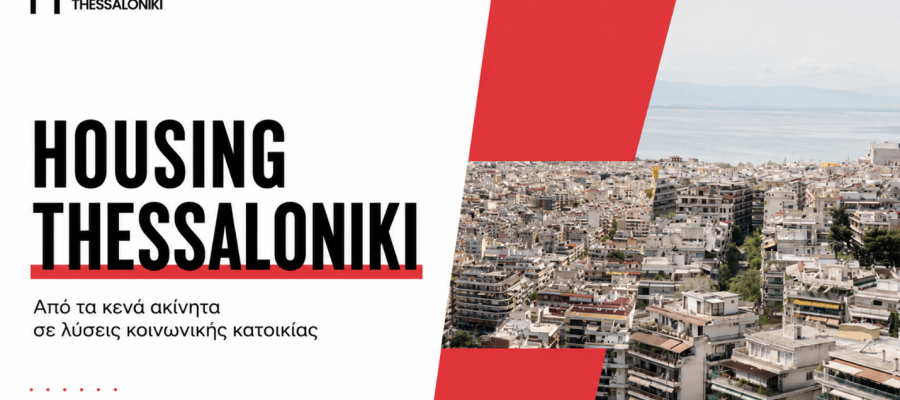
Housing Thessaloniki combines housing research, policy development, institutional coordination, and pilot implementation activities related to affordable housing and social rental mechanisms.
Housing research and data analysis
The initiative developed two city wide studies examining housing affordability, vacant housing stock, and housing challenges in Thessaloniki. According to the research conducted by the SRA, more than 16,500 homes remain vacant in the Municipality of Thessaloniki, while approximately 35,000 vacant former residential properties exist across the metropolitan area.
Social Rental Agency (SRA)
One of the strategic measures developed through the initiative was the establishment of the Social Rental Agency (SRA) under the auspices of MDAT. The SRA piloted a model for the generation and delivery of social housing using long term vacant housing units owned by public institutions.
Pilot housing intervention
The pilot programme included the renovation and energy upgrading of 40 vacant housing units through a single international tender process. The renovated units were matched with low income households through social rental mechanisms implemented in cooperation with public authorities.
Operational and legal framework development
Due to the absence of an established legislative and institutional framework for social housing in Greece, the initiative developed operational models and methodologies for:
- transfer of use rights
- tenancy agreements
- procurement procedures
- beneficiary matching systems
- social rent setting
- social monitoring and support procedures
The implementation of the pilot project also contributed to proposals for legislative changes related to social rental and social housing providers.
Involved partners
Major Development Agency of Thessaloniki (MDAT), Social Rental Agency (SRA), Municipality of Thessaloniki, Ministry of Family and Social Cohesion, regional authorities, public institutions, and stakeholders involved in housing policy, social inclusion, urban development, and energy upgrading interventions.
The initiative is supported through European funding mechanisms including the Recovery and Resilience Facility (RRF), ESF/ESF+, and ERDF.
Impact
- Renovation and energy upgrading of 40 vacant housing units
- Reuse of vacant housing stock for affordable housing purposes
- Development of a pilot operational model for social rental delivery in Greece
- Support for low income households through social rental mechanisms
- Development of methodologies for property assessment, beneficiary matching, tenancy agreements, procurement procedures, and social monitoring
- Contribution to legislative changes introducing social rental and social housing provider concepts into Greek legislation
- Creation of a model with potential for replication and scaling through future ESF+ funding mechanisms
Next steps
The initiative will continue supporting the implementation and expansion of the Social Rental Agency model through future ESF+ funding mechanisms and cooperation with regional authorities and municipalities. Future activities focus on the operation of social rental schemes, the further reuse of vacant housing stock, and the continued development of affordable housing and social housing mechanisms in Greece.