

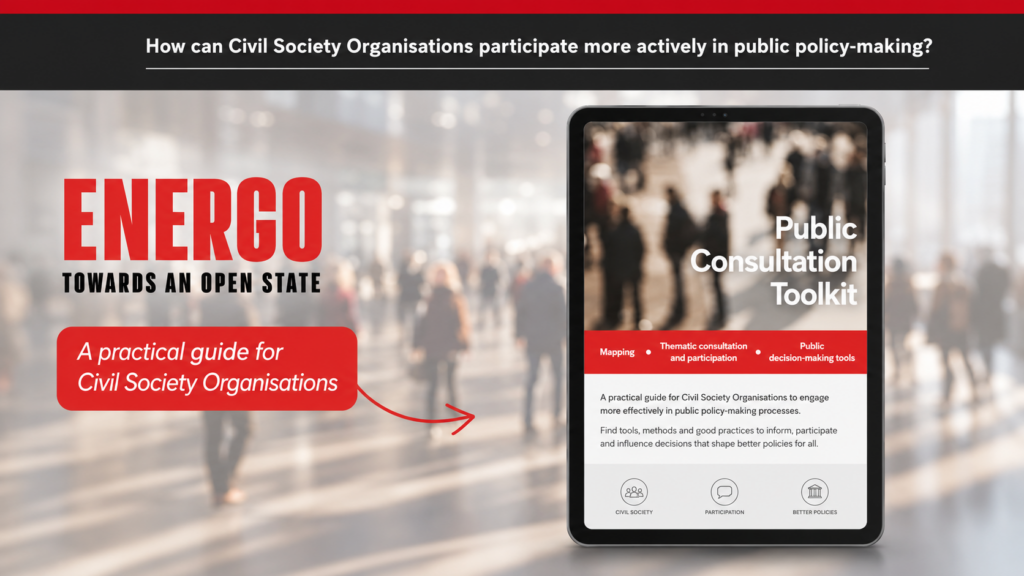
As part of the “ENERGO – Towards an Open State” project, HIGGS has produced the “Guide to Mapping Public Consultation and Institutional Participation Tools”.
The guide brings together the participation mechanisms available at local, national and European level, setting out for each one:
- how it works
- the openings it offers for CSO participation
- the requirements for access
- the main limitations and practical challenges of using it
The analysis draws on research and on experiential workshops with dozens of organisations, and arrives at a finding worth noting: the main obstacle for CSOs is not that tools are missing, but that the existing ones are fragmented, hard to see and complex to navigate.
How it is structured
1. Introduction and institutional landscape — the context in which the guide was developed and the challenges of the institutional environment.
2. National tools — OpenGov, the KEDE consultation platform and LocalWatch, Vouliwatch, the Ministry of Environment and Energy participation platform, the National Registry of Procedures (“Mitos”), Open Council and Crowd Participation, Diavgeia and “Pothen”.
3. European tools — Have Your Say, the European Citizens’ Initiative (ECI), Consul Democracy, Loomio, Decidim and others.
4. Choosing a tool, and conclusions — a consistent set of assessment criteria (purpose, responsible body, requirements, limitations) so that each organisation can select the tool that fits the aim of its intervention.
A practical resource designed to help organisations plan better-evidenced and more effective advocacy and public policy engagement.
About the project
“ENERGO: Towards an Open State – Participation, Advocacy, Empowerment of Civil Society Organisations” is implemented by HIGGS under the PLATO programme (Protecting democracy, human rights and the rule of law through an open civic space), coordinated by the Bodossaki Foundation in partnership with the NGO Support Centre. It is co-funded by the European Union through the Citizens, Equality, Rights and Values (CERV) programme, the Bodossaki Foundation and the NGO Support Centre.
The guide is available to view and download here.